In amongst the many genealogical treasures I have discovered, there was a biography of Walter Cushing Allison, type-written on 16 pages. I suspect it was written by his son Joseph Ringen Allison (my grand-father), but there is also a notation on the top of the document: Sclanders. The document has edits in pencil and includes, hand-written, the names of Joseph's first two children (Joanne and Helen). This suggests that it was written sometime before their birth and updated afterwards. The Sclanders reference may be to an author named Ian Sclanders who wrote about New Brunswick history, including This New Brunswick: A Parade of People and Places and Story of Saint John New Brunswick. The latter appears to have been jointly edited and published in 1935. I wonder whether this was a chapter in that book. Sclanders and his editing companions are even referenced in the biography suggesting they were all friends. Two possibilities, then: Ian Sclanders wrote it and sent it to Joseph or Walter for editing; or, Joseph wrote it and submitted it to Ian Sclanders for publication in this or another book. There are a couple of paragraphs in there which seem a little more personal in nature, and suggest that the book was written by Joseph. I have reproduced it here so you can be the judge. There are some interesting family story nuggets in here. To any of my relatives residing in Saint John, if you ever visit the public library, check out whether they have a copy of Ian Sclanders' work and help us figure out who wrote this piece.
Walter C. Allison
In spite of the duties that devolve on him as president of one of
the largest retail establishments in Eastern Canada and a director of a number
of other important companies, Walter Cushing Allison has found time to play a
leading role in many community efforts – among them civic reforms, the
establishment of playgrounds, a successful movement to modernize and beautify
the streets, and Board of Trade efforts.
Into his busy life he has also crowded an active interest in
agriculture, which left him to rise purebred stock; in real estate, to
developing the exclusive Country Club Heights at Riverside, and in assisting
those who suffer from tuberculosis, for whom his sympathy has been the deeper
because he himself, earlier in life, was handicapped by lung trouble.
 |
Walter Cushing Allison with his parents
Joseph and Matilda |
Mr. Allison was born in Saint John on April 12, 1873, a son of the
late Joseph and Helen Matilda Allison.
There were three children in the family, Water Cushing, the oldest,
Helen Gertrude, who died at the age of 24, and William Scammell Allison, whose
death occurred in 1925.
Not only as a merchant but as a citizen Walter Cushing Allison has
followed closely in the footsteps of his father, one of the founders of the
great firm of Manchester Robertson Allison, Ltd.
Joseph Allison inculcated into both his sons his integrity and
industry, and his ideals of good citizenship.
He had worked his own way up from the bottom. He saw to it that his oldest son obtained the
same grounding as he had in the hard school of practical experience. When Walter Allison put on his first long
pants and launched into his business career, his father started him on the same
basis as any other was entering the firm’s employ, nor was there favoritism in
the matter of salary. Mr. Allison’s first
week’s wages were $1.50.
Joseph Allison as a boy had left the paternal farm at Newport,
Hants County, Nova Scotia. He first went
to Woodstock with his half-brother Reverend John Allison, a Methodist
clergyman, but after a short time there he came to Saint John, bent on trying
his fortune in a larger center. At the age of 15 he obtained employment with
wholesale dry goods firm of Daniel and Boyd.
There it was that he met the men who were to be his partners in
business and his friends through life: James Manchester and James F. Robertson.
The three became inseparable companions and even as young men they laid plans
for the enterprise that was to raise them to the realm of merchant princes. When
he left the firm of Daniel and Boyd to join retail concern of Magee brothers
the other two followed him. It was part
of their scheme that they should learn the retail as well as the wholesale
business.
They worked hard, they acquired knowledge they saved. Then came the day in 1866 when they stepped
out for themselves, when they open their own store in the Ennis and Gardner
building on Prince William Street. A business was founded.
It must have been with his own experience in mind that Joseph
Allison guided the early stages of his oldest son’s career. After Walter Cushing Allison had been
educated in public and private schools in Saint John, and spend the winter with
his cousin, the late George S. Cushing, on his Florida orange Grove for his
health, which had not been robust, he entered the employ of Manchester
Robertson Allison at the age of 17. That was on September 1, 1890.
 |
| MRA, circa 1920 |
The boy was full of enthusiasm over his new job and his plans for
the future - too full of enthusiasm for his own good his father judged.
“Well, my boy,” the older man advised, “moderate your transports.”
The words have never been forgotten and Walter Allison has passed them on as
sound advice to many of his own employees.
Mr. Allison spent a year in the office of his father’s company,
sitting on the high stool and working over the retail daybooks with H.W.
Brodie, who is now a prominent official of the Canadian Pacific Railway.
He was next transferred into the store, to work behind the counter
in the various departments, to learn the principles of salesmanship and how to
deal with the public. From there he went to the wholesale department of the
firm, then an important part of the business; then he was moved back into the
office.
At 20 already entered the spurs, prove his worth as an employee,
and he was to be rewarded by an experience he has always remembered. His father decided that the time had come for
him to go to Europe, to familiarize himself with the dry goods markets of that
continent.
Mr. Allison was sent to the London office which Manchester
Robertson Allison then maintained and which was in charge of the late W.J.
Sutherland. He spent 18 months there making frequent trips to the dry goods
centers in other parts of England, as well as in Scotland, Ireland, Germany,
France, and Belgium. In that year and a
half he acquired a knowledge of merchandise that has been of value to him ever
since. It was there that he got the atmosphere, the background, the romance of
the goods in which his company deals, where these goods were made, the kind of
people they were made by and the manner of their manufacture.
Thus it was with new interest that he plunged into his work when
he returned to Saint John and again went into the wholesale branch of the
company, to serve successively in its different departments and familiarize
himself with each.
But in 1897, his career as a merchant was to be ended for the time
being. His health failed. He developed lung trouble. After a few months in
California and out West, he came home for a brief period, but physicians
decided it was necessary for him to go to Denver, Colorado, where the
high-altitude - a mile above sea level - was at that time consider beneficial
to the lungs. Mr. Allison was under
medical treatment for a year there, letting the out-of-doors most of the time,
then gradually regaining his health.
It was in Denver that he
met Harriet Belle Ringen, of St. Louis, the daughter of the late John Ringen,
of the Ringen Stove Company, which was the foundation of the American Stove
Company. Mr. Allison and Miss Ringen were remarried in St. Louis in 1900, and
returned to Denver to live.
 |
| Walter with his first wife Harriet Belle Ringen |
There, in 1901, Mr. Allison opened a real estate agency and
brokerage, which he continued for several years. He also acted for the Denver
company that put on the market what is known as Country Club Place, a 100 acre
tract immediately adjoining the New Denver Country Club, which became an
exclusive subdivision.
It was this that gave him the idea of carrying out a similar
scheme in Saint John in his Country Club Heights. His experience in Denver left him with an
interest in the real estate business that did not wane when he re-entered the
firm he know heads, and in 1913, he decided to make a start on the idea he had
had for some time developing subdivision joining the Riverside Golf and Country
Club, along the lines of the subdivision he had successfully launched in Denver. With his father and his brother, the latter
managing the property through Allison and Thomas, he formed a company which
required 185 acres in Riverside and began the development of it as a restricted
residential area. This tract is now one of the showplaces of this part of New
Brunswick.
While Mr. Allison was still living in Denver his daughter, Helen
Ringen Allison, now Mrs. James V. Russell, of Rothesay, was born. They left
Denver in 1906 to return to Saint John and again enter the firm of Manchester
Roberts and Allison, of which he had been made a director during his absence,
when Mr. Manchester retired and the company was incorporated.
In 1910, Mr. Allison’s son, Joseph Ringen Allison was born. Soon
after that, his wife died suddenly.
Mr. Allison’s father had devoted 20 years of effort and a large
amount of his own money to bring about the establishment of Rockwood Park and
Horticultural Gardens. To round out his part in this he contributed the land
for the Allison Grounds while his wife contributed funds for the zoological
attractions, including the bear pit.
His desire to provide something of value to the city where he had
risen from the status of the humble clerk to that of partner in a great
business lived on his son.
When Walter Cushing Allison sought an appropriate way to
perpetuate his wife's memory, he decided to establish a children's playground.
He cooperated with A.M. Belding and Miss Mabel Peters in forming the Saint John
Playgrounds Association and obtained from the city a piece of land south of the
exhibition buildings. There he financed
the creation of the playground, putting up the building and installing the play
facilities on the land, and dedicated it to his wife. These facilities he
turned over to the Playgrounds Association, which he afterwards served for
sometime as vice President and for some years paid all the expenses of
operating this playground.
Mr. Allison also supervise the establishment of the Carleton
Playground in front of the present community hall on the Westside, devoting a
good deal of effort to this.
During his years in Denver, Mr. Allison has been impressed with
the way in which the streets were being laid out and beautified in the growing
Western cities. It was only a short time before his wife’s death that he determined
to lead the movement to have his own city beautified in the same way.
He was been living on Germain Street. Enlisting the support of
other residents on that street he successfully induced the Common Council to
approve it under the abutters’ plan with paving, grass plots, greens and modern
sidewalks. This was done on the stretch from Duke to Princess Street.
St. John had little paving at that time, and none on residential
streets, and few of the attractions of the modern city, so far as the streets
were concerned. The Germain Street improvement presented citizens with a
concrete example of what could be done to make their city more attractive and
had far-reaching effect. Mr. Allison’s ideas were shortly put into practice on
a large scale and extensive paving program launched.
It was in the few years prior to the outbreak of the Great War
that Mr. Allison became interested in Board of Trade work and he was one of the
members of the active section known as the advertising committee, which was
under the chairmanship of Howard P. Robinson. This committee came to believe
that a change in the civic government from the old aldermanic form to the
commission form, which was then being taken off the many centers, would be
beneficial.
Mr. Allison was chairman of the subcommittee of three, which had
Mr. Robinson and William S, Allison has its other members, that gathered information
from 67 centers, over a period of several months, regarding forms of civic
government. On the basis of this information a campaign was launched for the
commission form of civic government here. This was obtained after a two-year
fight.
Other lines of Mr. Allison’s activity as a citizen include his
efforts in behalf of the Boys Club in its early days, in which A.M. Belding was
the central figure, and his work to foster the Travelers’ Aid.
In 1914, Mr. Allison’s health failed again. His old lung trouble
flared up and he suffered a nervous breakdown. This necessitated his retirement
for five years, six months of which he spent in a sanitarium in Ontario.
Not long before, Mr. Allison had moved his residence from Saint
John to Rothesay and started building up his beautiful property Woodside, one
of the finest estates in the Province, named after his grandfather's farm in
Nova Scotia, which was the birthplace of his father. There, during the latter
part of this illness, he started raising purebred stock: cattle, sheep, hogs,
and poultry.
He raised several hundred young hogs annually, animals of such
quality that they were sold to agricultural societies for the improvement of
swineherds. Mr. Allison was never able to supply the demand for these hogs, the
bacon type of large white Yorkshires.
His sheep were Shropshires, which combine mutton and wool to the
fullest degree, while his cattle were milking Shorthorns, a combined dairy and
beef the animal, which he had decided was most suitable to the needs of the New
Brunswick farmer after many discussions with government agricultural officials.
Mr. Allison gained his practical knowledge of agricultural in
early life. As a boy he spent much time on the farm of his maternal grandmother
at Hortonville, near Grand Pre, Nova Scotia.
His father’s partner, Mr. Manchester, had a fine farm on the
property where he lived on Manawagonish Road, as well as a second farm, the “Globe”,
on Bay Shore. In 1894 - 1895 when he went away on an extended trip, he left Mr.
Allison to manage these properties.
Mr. Allison’s interest in agriculture has extended beyond his own
farming operations, which he was forced to drop because of pressure of other
affairs when he became president of Manchester Robertson Allison Ltd. For a long period, he was director of the
Saint John Exhibition Association, serving the good part of his time as
chairman of the agricultural committee and for one year as Vice-President of
the association.
When Manchester Robertson Allison Ltd. Was incorporated after Mr. Manchester’s
retirement the directors were James F. Robertson, Joseph Allison, W.H. Barnaby
and T.E.G. Armstrong, all deceased now, and Walter C. Allison. Walter C.
Allison became president of the firm in 1925 after the death of Mr. Robertson
and his father.
The next year he received a great blow when his brother, William,
died. The two had been inseparable and the ties of companionship and affection
between them were even stronger than the ties between most brothers.
 |
| Frances Salter Allison |
It was in 1925 that Mr. Allison was married again, to his cousin,
Frances Salter Allison, of Newport, Nova Scotia, and this has also been a very
happy union.
The lung trouble from which Mr. Allison suffered in his younger
days gave him a deep sympathy for others so affected and a desire to assist
them. He became interested in the Saint John Tuberculosis Hospital, and is the
provincial government appointee on the board of that institution and one of the
board’s active members.
Mr. Allison is director of the number of large companies including
the New Brunswick Telephone Company Ltd., the New Brunswick Power Company and
the Maritime Trust Company. He is, besides being president of Manchester
Robertson Allison Ltd., President of the Vassie-Brock-Manchester Realties Ltd.,
and Realties Development Ltd.
For many years Mr. Allison has been a director of the Saint John
Board of Trade, serving as chairman of agricultural committee. He is also the
director of the New Brunswick Museum and a member of the Union Club, the Riverside
Golf and Country Club and the Canadian Club.
In both Saint John’s sesqui-centennial celebration in 1934, and
the Silver Jubilee celebration and transportation festival held in 1935, Mr.
Allison played an outstanding part. He was chairman of the program committee of
both events, originating the programs and directing them. In the case of the latter celebration he was
also chairman of the booklet committee, which published “The Romance of a Great
Port” of brochure edited by Frederick William Wallace assisted by Ian Sclanders
and giving the history of Saint John’s port from shipbuilding days down to the
present.
 |
| The Allison residence at Woodside |
All his life Mr. Allison has been an ardent angler, and for 40
years he fished on South Branch Lake, in the Oromocto district. On his
beautiful Rothesay property, he has a small artificial lake, stocked with
trout. An enthusiastic golfer, as well, he also has a 10 acre golf course laid
out on his property, a practice ground where it is possible to place eight
holes. Horses or another of Mr.
Allison’s enthusiasms and he formerly had both riding and driving horses.
He is a voluminous reader, and his preference is for books of
history, biography and travel.
Mr. Allison was born a Methodist and a Liberal. In his earlier
days he was very active in the affairs of the Centenary Church. In politics, he
has taken no active part, although he has several times been asked to offer as
a candidate.
“Of late years,” he told a reporter not long ago, “I’ve had a very
definite feeling that the present system the party politics, partisan politics,
is not all that the country needs. I believe that it will eventually have to be
supplanted by something better.
“I think there’s a tendency toward too much government
interference with business. Men experienced in their own line of work are much
better equipped to carry it on themselves, although it may sometimes be
necessary for them to be supervised by government, so the greed will not get
the better of good judgment and fair play.”
Mr. Allison comes of Scotch-Irish stock. Scottish, originally, the
family emigrated to Newton-Limavady, in Northern Ireland, then move to England.
There Mr. Allison’s great-grandfather rented a large farm from a landed
proprietor. There is an interesting story behind emigration of the family to
Canada.
John Allison, Mr. Allison’s great-grandfather, had enjoyed several
prosperous years on the farm he rented in England. This would enable him to
furnish his home with some degree of luxury. The steward of the estate called
annually to collect the rent. On this occasion, in 1729, he stayed to have
dinner with John Allison.
As the story has been passed down, the steward cast an avaricious
and perhaps envious eye over John Allison’s household belongings and decided
that if the tenant were so well-off, he should be processed at a higher rent.
When he broached this, and endeavored to raise the rent, it so incensed Mr.
Allison that he decided there and then to journey to America and acquire his
own land.
With his family, he sailed for Philadelphia. The ship was wrecked
on Sable Island, but the passengers were rescued. At that time, efforts were
being made to increase colonization in Nova Scotia and the authorities at
Halifax induced the Allison family to settle there, instead of continuing to
Philadelphia.
In the depths of winter John Allison snowshoed from Halifax to
Newport, to inspect the thousand acre property he was to buy.
The snowshoes which he used, round Indian made snowshoes, the gut
in them as good as the day they were strung and now nearly 160 years old, are
among the present Mr. Allison’s most prized possessions, prized the more
because they are, in some measure, symbolic of the independence and courage of his
forebears.
Walter Cushing Allison, besides his wife, his son Joseph Ringen
and his daughter Mrs. J.V. (Helen) Russell, has four grandchildren: John Allison
Russell, David Allison Russell, Joanne Hayward Allison and Helen Allison.
 |
| Walter with his son Joseph and daughter Helen |
Afterword: There are several inaccuracies in this biographical account. First, the Allisons emigrated from Ireland, not England. Second, the boat did not crash on Sable Island, although did become disabled off the coast of Nova Scotia and made its way slowly into Halifax harbour.


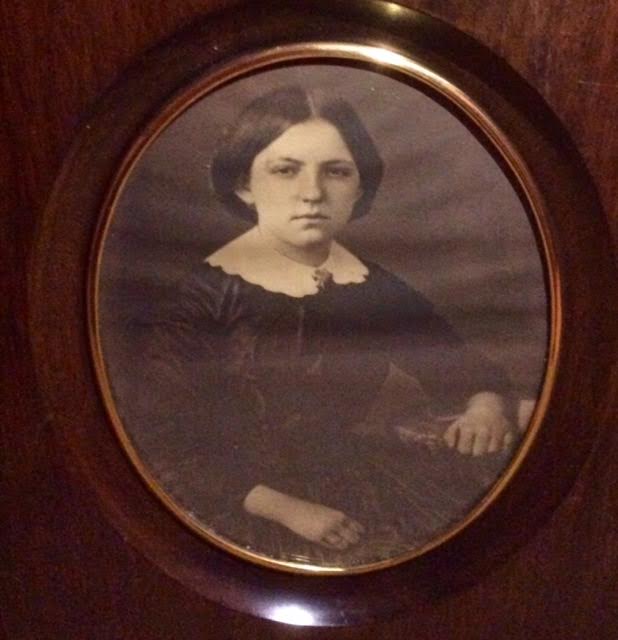


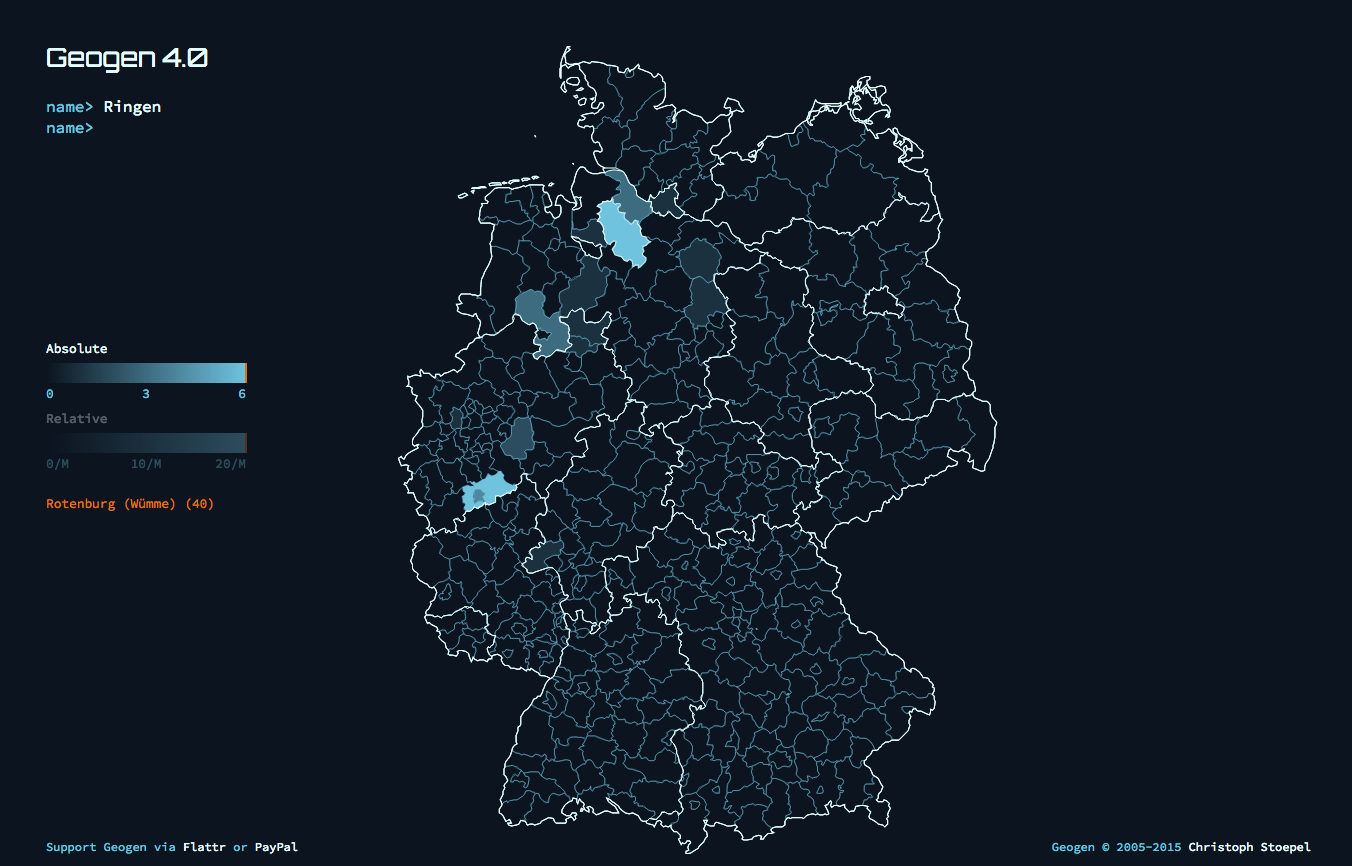 Two sources that I turned up: a surname distribution map for Germany, and
the Breddorf phone book. Something else
I now know. Most Germans with the
surname Ringen are from the area around Breddorf, and there are still a number
of Ringens living in and around the Breddorf area. Perhaps some cold calls to see if any of them
have missing ancestors named Johan in their family trees? The search continues.
Two sources that I turned up: a surname distribution map for Germany, and
the Breddorf phone book. Something else
I now know. Most Germans with the
surname Ringen are from the area around Breddorf, and there are still a number
of Ringens living in and around the Breddorf area. Perhaps some cold calls to see if any of them
have missing ancestors named Johan in their family trees? The search continues.


