|
| John Ringen |
You may recall that it was Hattie Belle Ringen who first got me excited about my most recent genealogy voyage. I had found
relatives of Hattie’s going back to the mid-1800s in the US. It was
pretty exciting to learn that her father, John Ringen (my
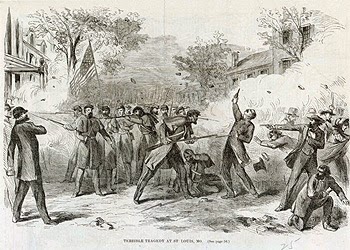
great-great-grandfather), was mixed up in the Civil War, and started a stove
company, which is now Magic Chef. I was
always stumped, though, by the fact that I could never find ancestors for John
Ringen. Recently, I reinvigorated my
quest to find out more about where John Ringen came from. I started with what I knew based on other
people’s ancestry.ca’s family trees:
John’s father’s name was Unk – and he was born in Germany. I searched high and low for Unk Ringen. Nothing.
 |
| We believe this picture to be Hattie Belle Ringen |
After significant internet research, and
based on some past luck with the magic of Google, I decided to simply type in
“origin of the German name Unk.” Imagine
the anticipation… and then the hilarious disappointment. Practically the first thing to come up was
that “unk” is an abbreviation for “unknown” which is commonly used in genealogy. On the one hand, that clarified
something: I definitely don’t know
John’s father’s name. On the other hand,
I was starting from scratch… again.
I started with what I know absolutely to be
true: John’s naturalization and census
records from America.
There are lots of immigration records and
passenger manifests for Germans seeking a new life in America. Based on John’s naturalization papers, I know
that John probably came to America around 1845.
At that time, John would have been only 11 years old, so it’s possible
his memory of his passage and the details could be sketchy. The year was, therefore, still a question in
my mind.
I searched every ship manifest – pouring
over passenger lists for a Ringen family with an eleven (or thereabouts)
year-old son. Nothing. So back to basics and what I know, and there is a
lot I do know about John. John married Louisa
Heinzelman. The Heinzelmans likely came
from Wurttemberg in Germany around 1837.
This conjecture is based on an immigration record from Johann Adam
Heinzelman, with the right birth date for Louisa’s father, JA Heinzelman. So perhaps our John Ringen came over with
the Heinzelmans. No luck. The Heinzelman’s lived in Cincinnati before
moving to St.Louis, which is where they met John Ringen and his buddy Henry
Timken.
We definitely know the Heinzelmans, Timkens
and Ringens were hanging out in Missouri. Henry Timken and John Ringen were best
friends. In a previous blog I chronicled
their joint adventures as entrepreneurs and Gold Rush enthusiasts. They also both married Heinzelmans
(Fredericka to Henry and Louisa to John).
We know they all lived in St. Louis and that there was a fairly
significant German community there, including many who fought for the Union
side (including John and Henry). Other
than this, I wasn’t sure of family or other connections.
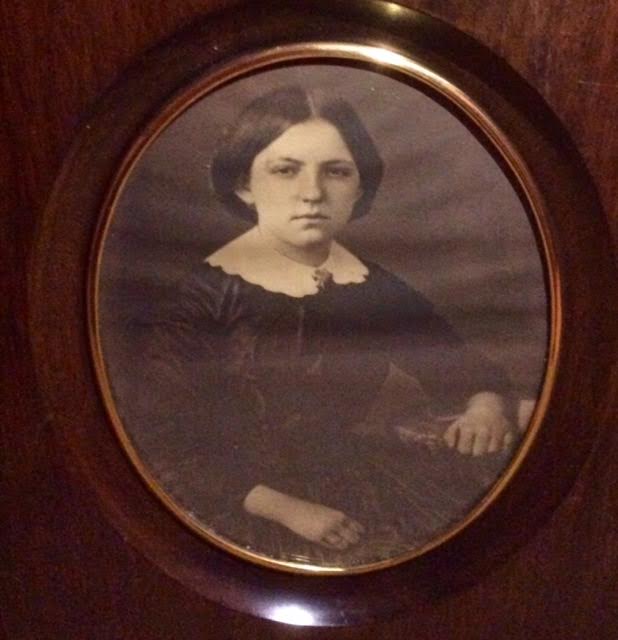 |
| Louisa Ringen nee Heinzelman |
And then – the wonder of the internet. Through the blog, a couple of Ringen
descendants have been in touch, and this has brought me a few interesting
tidbits.
Firstly, something I didn’t know was that
John Ringen was related already to the Timkens through marriage of distant
cousins: Gerhard Ringen and Adelheid Timken.
This I learned because of research into John’s friend Henry Timken. Henry Timken, in turns out, was an even more
successful entrepreneur than John. Henry
Timken started with ball bearing production, and it has since grown into a
successful publicly-traded company.
Because of Henry’s fame, we can find out a little more about our
John. For example, Henry Timken hails
from Tarmstedt in Bremen, Germany. Henry
is related to Jacob Timken, and Jacob Timken’s daughter, Adelheid, married
Gerhard Ringen. Sources, including
census, confirm that Jacob lived with Aldelheid and Gerhard until he died in
1866.
 |
| John Ringen's passport application 1880 |
Making connections between our John Ringen
and the Timkens helps us get a little closer to John Ringen’s roots in
Germany. In fact, further search turned
up John Ringen’s 1880 passport application, in which he cites Breddorf, Germany
as his birthplace, a stone’s throw from the Timken’s original farm in
Tarmstedt.
Being clearer about John’s birthplace, I
could search historical documents and see how people from that part of Germany
travelled to America in the 1800s.
John’s naturalization document shows the year of immigration at 1845. Germans who travelled to Missouri at that
time typically moved through New Orleans.
Since he would have been around eight years old, I was looking for
Ringens or Timkens who travelled to New Orleans in the time period and who may
have had a child with them. More
disappointment.
 |
| Census record showing Timkens and Ringens |
I painstakingly reviewed every passenger
list for 10 years before and after John’s estimated year of arrival (1845). I simply can't find anything that proves when
our John arrived and with whom. Before I
started this research, however, I didn’t realize just how many Germans from
Bremen came to the United States at that time. In fact, Germany played the
greatest role in populating the United States during the 1800s. Between 1820 and 1910, five and a half
million Germans settled in the US, primarily in the central farming states.
During this period, most Germans left from
Bremen or Cuxhaven. The port at Bremen
(Bremerhaven) was the likely port of departure for John, since he was born not
far from there in Breddorf. Unfortunately,
most of the passenger lists from Bremen have been destroyed. We are pretty certain that the Ringens were a
farming family, and cousin Gerhard had his own farm. As industrialization took over in Germany,
land prices increased and farming income became unsustainable. Conscription affected many of the poorer
farming families who were losing their male children to wars. For our Ringens, it is possible that the crop
failure in the 1830s and 40s encouraged their departure. A growing German community in the United
States meant that while emigrants were leaving Germany they felt they had
somewhere safe to go to, where cheap land meant a more stable future.
Here is what I still don’t know: with whom did John travel to
the United States? Who were his parents
and did they come along? Do we have any
relatives left in Germany? On this last
one, there may be clues.
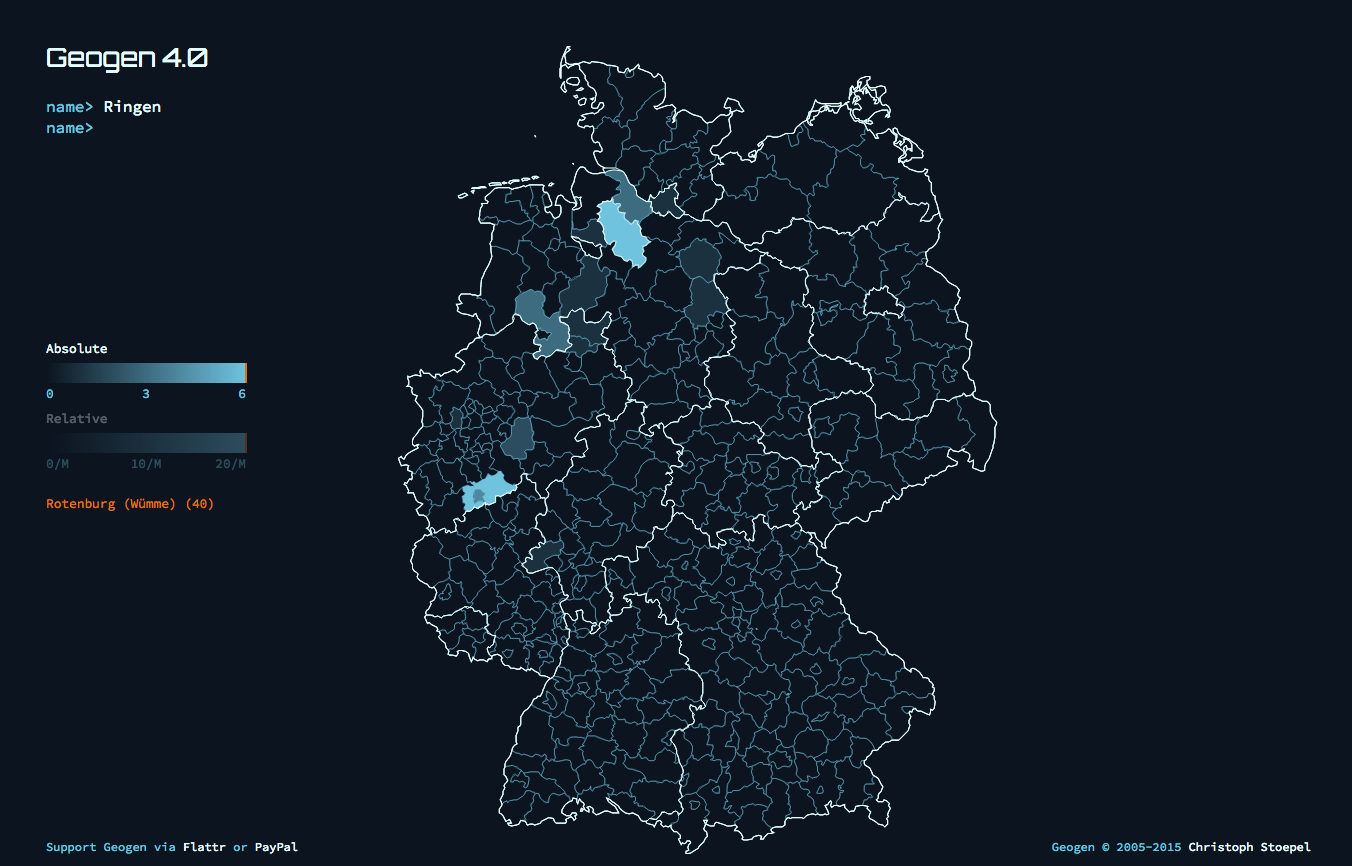 Two sources that I turned up: a surname distribution map for Germany, and
the Breddorf phone book. Something else
I now know. Most Germans with the
surname Ringen are from the area around Breddorf, and there are still a number
of Ringens living in and around the Breddorf area. Perhaps some cold calls to see if any of them
have missing ancestors named Johan in their family trees? The search continues.
Two sources that I turned up: a surname distribution map for Germany, and
the Breddorf phone book. Something else
I now know. Most Germans with the
surname Ringen are from the area around Breddorf, and there are still a number
of Ringens living in and around the Breddorf area. Perhaps some cold calls to see if any of them
have missing ancestors named Johan in their family trees? The search continues.
Afterword:
Just before I finished this blog, I
attended a workshop sponsored by the Victoria Genealogical Society in which
Gerry taught us some tips and tricks around searching on ancestry.ca. Most of his tips I knew, but a couple were
golden and well worth the time and money for the workshop. One was use of the wildcard in the
search. Just when I had completely given
up, I tried a wildcard search and found a possible match. Right age, right location, but the name was
messed up (J??? Rinke), and it was a few years off in terms of arrival. A website describing passenger lists from
that ship, the Corsaire, note a number of errors and inconsistencies in names
making matches extremely difficult.
Could this be our John? If so, he
was travelling with two women, one presumably his mother, a 54 year-old named
(possibly) Catherine, and another female, presumably his 17 year-old sister
named Maria. Another record shows a John
Rincke travelling on his own at the age of 14, arriving in New York on the ship
Nestor in 1845. This one has the right
first name, the right year, but the wrong age and surname spelling for young
John. It is hard to say whether either of these is our John Ringen. Perhaps there is a record I have yet to
uncover… The search
for the Ringens in Germany continues.


Sources:
Various census, naturalization
and travel documents
Timken: From Missouri to Mars--a Century of
Leadership in Manufacturing
By Bettye
Hobbs Pruitt