Showing posts with label Hayward. Show all posts

Thursday, 7 March 2019

The Maugerville Settlement

Well before the influx of Loyalists to what would become New Brunswick, New Englanders decided to leave their home in Massachusetts to set up a new settlement in the Colony of Nova Scotia along the Saint John River. The governor and council of Nova Scotia were working to procure loyal citizens to take up settlement for the areas from which the Acadians had been expelled most cruelly. New England was an excellent source of such settlers, as they were seeing increasingly less land available for settlement and they were from hardy settler stock themselves. They would be somewhat familiar with the climate and prepared to take on the work necessary to create a community.

After welcoming these newcomers for more than a century, the First Nations were beginning the see how continuing with a friendly greeting was not serving them well – so they objected to this plan. The British colonial government therefore took steps to dispossess Wəlastəkwiyik indigenous peoples[1] from their territory, inconsistent with previous Treaties and Royal Proclamations. The indigenous First Nations objected to the first survey party’s efforts, so the surveyors, led by Captain Peabody, moved downriver and surveyed an area of 100,000 acres, 12 miles further along the Saint John River. The Wəlastəkwiyik peoples were unaware of the activity, so the survey was completed and the land registered for settlers from New England.
Riverboat Landing Maugerville 1915
New Brunswick Archives

The surveyors were looking for larger lots of land for farming, land that was becoming more difficult to come by in their homeland. The settlers were looking to create a new livelihood just as their forebears had done in the wilderness of New England. In 1763, 200 families travelled in four vessels to establish a new township named Maugerville. These 800 people made up the first full settlement on east bank of the Saint John River after the defeat of the French at the hands of the English. When these New England settlers first arrived they were threatened by the Wəlastəkwiyik peoples – but an amicable arrangement was reached two years later in 1765. From this point onward, the First Nations of the area saw their way of life diminished as the settlers made their imprint on the land.

The settlers were descendants of the Puritans, members of the Congregational Church, and considered “Protestant Dissenters.” They settled in a wilderness: no roads, no established trade routes, no town centres, no schools. The families were each allotted land with river frontage, and were required to clear it for agriculture, build schools and churches, and make their homes. They remade their lives and established their values in what was then Nova Scotia, at a time when the colony was on the brink of the massive change that would come with the Loyalists.

Among those who first settled in Maugerville was the Estey family. Richard Estey (1706-1791) was a well respected member of the community, and one of the first elders of the Puritan church. The church, in fact, was one of the first community buildings constructed by the settlers, finished in the first year of their arrival. The church covenant read, in part:
And respecting Church discipline it is our purpose to adhere to the method contained in the platform for the substance of it agreed upon by the synod at Cambridge in New England Ano. Dom. 1648 as thinking these methods of Church Discipline the nearest the Scripture and most likely to maintain and promote Purity, order and peace of any.

Among the signatories of this covenant was Richard Estey, dedicated, along with his Puritan brethren, to watch over the community to ensure maintenance of these values and ideals. The church members took seriously their need to discipline their members for breaches of the church doctrine, and a number of records point to Richard Estey being among those who witnessed sins being committed by community members.

Zebulon Estey (1742-1806), Richard’s son, was a deacon in the Baptist Church in Maugerville. He also received one of the land grants for the Maugerville settlement. A 1783 report on his claims for land described him as “a good man, his character very loyal”. He had a wife and eight children.

Joshua Mauger
The New England settlers had to fight for their land in Maugerville three times. The first, their original settlement in the lands surveyed by Captain Francis Peabody at the behest of the colonial government. Then they found that their settlement had been allocated to former British soldiers. As a result, they petitioned Joshua Mauger, an agent of the colony who had been ten years in Nova Scotia as a merchant. Mauger worked on their behalf in London and succeeded in having their original claims confirmed – and the settlement was thereafter named in his honour. This was the year 1764, and the order confirming their allocation reads:
At the Court of St. James the 10th day of February 1764. Whereas the Lords Commissioners for Trade and Plantation have represented to his Majesty at this Board that a memorial has been presented to him on behalf of several disbanded officers of his Majesty's provincial forces in North America, setting forth that induced by several encouragements they have sold their lands in New England and settled themselves and families upon the St. John River in his Majesty's province of Nova Scotia, at the distance of 200 miles from any other settlement belonging to his Majesty's subjects, and praying that the possessions of the lands upon which they have settled themselves at a very great expense may be confirmed to them by his Majesty.
The Governor of Nova Scotia is ordered to cause the land upon which they are settled to be laid out in a Township consisting of 100,000 acres 12 miles square, one side to front the river. Also to reserve a site for a town with a sufficient number of lots with reservations for a church, town house, public quays and wharves and other public uses; the grants to be made in proportion to their ability and the number of persons in their families, but not to exceed 1,000 acres to one person.
That a competent quantity of land be alloted for the maintenance of a minister and school master and also one town lot to each of them in perpetuity.
Upon the arrival of the Loyalists, the settlers had to defend their titles, and their religion, once again. As the next chapter will show, the population boom that ensued meant that what was once a generally homogeneous settlement had become crowded with members of other churches and new values. The influx meant the creation of a new colony of New Brunswick, in which the Maugerville residents were an out-of-place minority.

In 1802, Maugerville residents, including one Zebulon Estey, had to petition the Legislature for the right of their duly elected Ministers to solemnize marriages. They also had to individually prove their claims to land in order to maintain their original allocation. The fight for Puritan values, however, was already lost when their population was overwhelmed by other denominations.

Among the children of Zebulon Estey and Molly Brown were two daughters: Elizabeth Brown Estey and Dorothy Dolly Estey. Elizabeth married Samuel Upton, and Dorothy married David Currey. Their children (first cousins) Ann Upton and John Currey respectively would marry, bringing together these branches of the family tree. Their child, David Samuel Curry (1825-1896) married Martha Elizabeth Hay, daughter of William and Eliza Hay[2].

NOTES:
[1] Also known as the Maliseet First Nations: the people of the Wəlastəkw (Saint John River) from its mouth to its sources.
[2] After much searching about the Hay ancestry, the facts are inconclusive as to the origin of the Hays. Even the birth and death dates of William and Eliza are conjecture. There is a well-known Hay family with a Loyalist heritage, however the facts don’t fit our Hay connection. For example, the William Hay in that Loyalist family was a baker in Saint John, whereas we are confident that our William was a farmer. A marriage record shows that William Hay married Eliza Hayh. It seems odd that they would have a similar surname, however marriages between cousins were not uncommon. It is also possible that the wrong surname was recorded. Without additional facts the ancestry of Martha Elizabeth Hay, beyond the fact that we know her father’s name is William Hay, will remain a mystery. 

Friday, 31 August 2018

The McDiarmids Move from Perthshire to New Brunswick

Killin in Perthshire is a peaceful Scottish village north of Edinburgh at the western head of Loch Tay. The west end of the village meets the beautiful Falls of Dochart which you cross over via a stone bridge. The village has been around for millenia, with stone circles as testimony to its ancient history. Its proud Scottish heritage includes the MacNab clan, once dominant in the area. By the end of the 18th century, when our ancestors left their homeland, the primary village industry was weaving the local linen, made from the flax grown in the area.

It seems likely that the McDiarmids lived and worked in this town prior to their departure for new lands in New Brunswick. Our first known ancestor, Archibald McDiarmid (1759 – 1841) appears to have hailed from this area. The only confirmed source of information we have on Archibald McDiarmid’s birth is the following report in the New Brunswick Courier on March 13 1841:
d. Mascareen, St George parish, Charlotte Co., 5th inst., Archibald McDIARMID, age 82, native of Perthshire, Scotland and resident of Charlotte County past 40 years.

It seems certain that Archibald McDiarmid was born around 1760 in Perthshire, Scotland. We are pretty confident he married his wife Catherine in Scotland, and they both made their way to Canada. By 1800 they were both in Canada, and had settled in New Brunswick.
The number of McDiarmids, and Archibald McDiarmids, who arrived in Canada around that time is pretty extraordinary. There are plenty of McDiarmids in Perthshire as well, and Archibald is a common Scottish name. In fact, there are two Archibald McDiarmids born to a John and a Katherine, both from Perth, and both born within two years of each other, and three Archibald McDiarmids born within three years of each other from the same Parish. Without other clear evidence about which of these actually left for Canada, it is impossible to know Archibald’s parents (although there are many guesses on the online genealogy databases).

There are lots of competing records of Archibald McDiarmids in Canada who arrived around that time. They settled in Nova Scotia, New Brunswick, Manitoba, Ontario and Quebec. We can, from the death notice, trace our ancestry back to the Archibald McDiarmid who settled in Mascarene, Charlotte County, New Brunswick around 1800, after the influx of Loyalists and as the new colony was coming into its own as a powerful economic force on the eastern seabord of North America.

In 1804, one Alexander McArthur fell on hard times: his property was seized and sold at auction. The land consisted of two lots of 50 acres each in the Parish of St. George, Charlotte County. The land was part of what was known as the Mascarene grant, and sat at the entrance of the Magaguadavik River (so named by the Maliseet First Nation, the original inhabitants of the area). The public auction took place on September 22, 1804. For 56 pounds and ten shillings, Archibald McDiarmid acquired this land, and it is here that he stayed as a yeoman farmer and raised his family.

The Magaguadavik River wanders almost 130 kilometres in New Brunswick before emptying into the sub-basin of the Bay of Fundy known as Passamaquody Bay. The area still has an element of wilderness to it: beautiful forest and rushing river. Like many early settlers, Archibald McDiarmid had the opportunity to make a life for himself here, with his wife Catherine. Together they had three sons: John (1809-1879), Archibald (1813-1872), and James (1818-unk), all of whom appear to have been born in New Brunswick (I say “appear” because some death certificates of their progeny suggest they were born in Scotland, however, the timing of the land grant, which is a strong piece of primary evidence, suggests not).

Archibald received a land grant in 1810, this time for 200 acres. He ended up living near the McVicar family – with whom one of his sons would be united in marriage.

A life near the sea appealed to Archibald and Catherine’s children as two of them ended up as lighthouse keepers or harbour masters. Archibald Jr. stayed Charlotte County, with his wife Mary Ann McVicar. He is listed as Harbour Master in 1851. His brother James is a farmer, living next door to Archibald Jr. with his wife Barbara.

John McDiarmid, married to Anne, became the lighthouse keeper at Point Midgic and died there in 1879, and his widow was still there in 1894 until her death at the age of 80, earning $200 annually for the pleasure of watching for ships in distress. This could not have been an easy life. Somewhat isolated, perched on the Bay, watching for fishermen, including her own children, that may have gotten into trouble.

Archibald Jr.’s children were all girls but for Silas (1853 - 1923), who left his home in Mascarene as a young man of 20. He joined the pharmacy business of E.J. Mahoney in Indiantown, an area of Saint John in the old north end by the water. The area was ravaged by fires in the late 1800s which destroyed homes and blocks of buildings, the worst one in 1877. It was around this time that Silas left Mr. Mahoney’s business and set himself up with his own drug store at the corner of Charlotte and Duke Streets. He passed this business along to Hazen J. Dick, his sister-in-law’s husband.

Silas’s next business enterprise opened in the Royal block at the corner of King and Germain. His wholesale business, the McDiarmid Drug Company, was later moved to Market Square and sold to the National Drug and Chemical Company. Silas’s business ventures were all successful. He and his wife, Ada Upham Curry, lived well in Saint John, and holidayed in exotic locales such as Bermuda.

It was 1922, as Silas was entering his 7th decade, that he became quite ill. Hazen Dick took over the retail business while Silas retired to recuperate. During this year, his wife, Ada Upham Curry, whom he married in 1885, died in a car accident. Silas himself died not long afterwards of myocarditis or inflammation of the heart.

Silas had seven daughters who were all raised in Saint John and were part of the successful business families of the city. Alice Pearl McDiarmid married William Henry Hayward, himself owner of a successful mercantile business. Enid McDiarmid married Harold Rising, a business man. Grace Chalmers McDiarmid married Frederic Stephen Smyth. Ada Mariam McDiarmid married Kenneth Allison Wilson, a barrister in the city. Audrey Elizabeth McDiarmid married druggist Louis Alberton Titus. Elsie Barbara McDiarmid married Lewis McCoy. Lulu Georgie McDiarmid married Donald Walker Armstrong, a bondbroker.


McDiarmid sisters (including their married names) - clockwise from top left: Enid Rising,
Audrey Titus, Lou Lou Armstrong, Elsie McCoy, Alice Hayward, Ada Wilson, Grace Smith 


Wednesday, 23 May 2018

Loyalists on Our Family Tree


Adam Sheriff Scott painting of Loyalist Landing in Saint John


The Nova Scotia colony at the time of the American Revolutionary War was a wilderness.  It was sparsely populated with a combination of hardy settlers from England and France, New England settlers at Maugerville, indigenous peoples, Acadians who had managed to stay behind or return after their violent expulsion, and former British soldiers (like our Henry Hayward).  The battle for American independence spilled into parts of the Colony, which saw attacks by Americans on outposts, farms, and anything else that would annoy the British.  Privateers sailed the Miramichi, the Saint John River, and along the Atlantic Coast, disrupting business and the private lives of the colonists.  This was a British colony, and while the indigenous peoples sided with both the British and the Americans, the colonists were decidedly British in their approach and orientation. 

Those colonists in America who chose to support the British side in the fight for American independence were known as Loyalists.  They were given assurances of their ultimate victory, as well as protection of their life, livelihood and property by the British Crown.  It was the height of British power in the world – the Empire had spread to all corners, and certainly in the late 1700s no British citizen could have foreseen the Empire’s defeat at the hands of American rebels.  That is, however, precisely what happened, and it left Loyalists no choice but to leave their homes and cash in on the British promise of protection.

New York was the former British Headquarters, and Loyalist refugees flocked there in droves to board ships that would take them to safety.  As Joshua Upham wrote to Edward Winslow:
We shall soon be with you – everybody, all the World moves on to Nova Scotia.

This is only slightly exaggerated: 35,000 people moved into the Maritime region, 15,000 to Sunbury and Cumberland Counties.  Loyalists moved from well-established American colonies and cities where the families had lived in relative wealth and comfort, to a wilderness – with land that had been undeveloped, and and no towns or amenitites.  They would have to not only make a home, but a community. 

The first few months, for those who landed in the summer, were a flurry of activity to build homes and construct the basic elements of community.  On May 10, 1783, the ship Union arrived at Partridge Island in Saint John harbour.  The Loyalists on board built quickly on Belleisle Bay, soon named Kingston. Those who landed later at what would eventually become Fredericton were in for a shock.   They had a harsh winter with unfinished homes and little in the way of supplies.  It wasn’t until the early summer of 1784 that the Loyalists celebrated the arrival of the first supply ship.  Borders were changed between New Brunswick and Maine, and some Loyalists had to move after they had already settled.  This continuing uncertainty would have made settlement complex:  disputes with the original settlers, changing borders, and the overall unsettling feeling that everything they had thought would be true simply wasn’t.

There were more people moving there than ever before in the history of that colony, necessitating dramatic action by the British.  This included the formation of New Brunswick by Order in Council on June 18, 1784.

The Loyalists had a sense of entitlement as a result of promises of the British Crown.  They lost everything: professions, livelihoods, homes, property, and many lives.  The settlers who had already been in what was previously Nova Scotia Colony for years, were concerned about dispossession and changes to their community values.  To them, the Loyalists were intruders with an undeserved sense of entitlement:  they didn’t settle this wilderness originally; they didn’t fight through those first dreaded winters without supply ships or outside help.  Disputes about property ownership were common, particularly if the original settlers had not adequately improved the lots they had previously been granted.  Original Nova Scotia land grants had to be re-issued for the Colony of New Brunswick.  Imagine being an original settler – you had done all of the work to create a new home, survived privations and privateers, and now you find yourself arguing for what was previously yours.  This would have been the ultimate insult, and certainly a threat to your way of life.

For a Loyalist to acquire land in the new colony, they had to prove they were deserving of the protection of and compensation by the British Crown.  The average size of a Loyalist grant was 100 acres to the head of the household (typically a man or a widow), and 50 acres for each additional family member.  Military personnel received more land and their allocation depended on their rank.  Governor Parr was at first responsible for surveying the lots.  Given demand from the incoming Loyalists and disbanded British regiments, this surveying could not keep up.  More concerns arose from existing settlers about demand for their properties, and the colony had to move increasingly quickly in order to stem unrest and ensure peaceable settlement.

For the colonial administration, they had a nightmare on their hands:  establishment of new lots of land, keeping the peace, creating a new colony, and ensuring that only those deserving received their land allocations.  As a colonial administration, this was really all done through the British government in London, with the Governor having some authority for establishing clear title and surveying property.  This was a slow process in the early weeks and months of 1783, with Governor Parr of Nova Scotia setting out land and authorizing Surveyor General Charles Morris the ability to lay out town lots in Parr and Carleton (what is now Saint John).

Things started to improve with the coming of Governor Thomas Carleton, who arrived in Saint John in November 1784 to establish the new government.  It wasn’t until January 1785, however, that the Government established a land committee that would expedite Loyalist applications.  The committee screened applicants, resolved disputes, inspected improvements, took over neglected older land grants, and dealt with land reserves for public, military and naval purposes.  Old records were reviewed and either determined to be no longer valid (for example if the land was undeveloped) or the grant was re-issued under the colony of New Brunswick.  Registrations, surveys, allocations, inspections were all expedited under this new approach.  George Sproule became the new Surveyor General overseeing this mammoth task.

As a result of this work, between 1784 and 1790, 476,024 acres of land was given to Loyalists (in 1783 only 13 grants totalling 8,039 acres were issued).  In 1786, at the height of demand for resolution of tensions and settling of claims, the land committee met daily and in this year 200,000 acres were surveyed and granted to Loyalists.  Another 184,000 acres was granted in 1787. 

It is difficult to appreciate this effort today, when we have electronic filing, geographic information systems, and a clear system of land titles.  The colonial government had to do all the work of land management, community development planning, dispute resolution, land surveys, and mapping beginning with little available or accurate information, a brand new colonial administrative government, and a population that was either impatient for reimbursement for their loyalty, or angry about the incursion of this new population into what they considered their territory, which they had previously worked so hard to claim.  This was no small feat.

It should come as no surprise that our Hayward ancestry includes Loyalists given our strong connections to New England and the history we share with the former colonies of both Nova Scotia and New Brunswick.  The surnames that I can definitely link to Loyalists are: Currie, Fritch and Crawford. 

William Crawford (1730-1817) and John Fritch (1734-1812)

William Crawford (1730-1817) was born in Ireland and came to Shrewsbury in the County of Worcester, Massachusetts Colony with his father, John and his mother.  When the American Revolutionary War came, that part of Massachusetts became the subject of attacks by rebel colonists against those who chose the British side.  In this testimonial, heard in January 1787:

…when Troubles broke out, (William Crawford) always took a part with the King.  In January 1778 (he) went within the Lines, had been condemned at a special Court for his Loyalty was sentenced to be put on board a Guardship, but made his Escape and got to Rhode Island.
                                                                                                     Heard Jan 17 1787

 William Crawford served with the British Lines throughout the war in the Quarter Master General’s Department, and later in the Barrack Department as a labourer.  He was one of many who, when evacuated, settled on the Kennebecasis River.  He also claimed other losses from his New England estate consisting of:  1 horse, 1 pair oxen, 3 cows, 2 calves, 1 yearling, 8 sheep, 5 lambs, 3 hogs and furniture.  William left everything on the farm when he left for Rhode Island to do his part for the British.

Claimants needed to have witnesses to their claims, and for William Crawford this was Colonel Williard, who swore that he had known the claimant for many years: 
No man has been more Loyal or more ready to Assist the British Army.  He went with the Army as a Mechanic.  His Father had a Farm at Shrewsbury, it seemed a good pretty Farm, it seemed a Comfortable place, thinks the Father and Claimant lived together.

In the meantime, the new Commonwealth of Massachusetts, Worcester Colony held a Court of Common Pleas in 1787 during which all of William Crawford’s possessions were confiscated as he was an “absentee”, a term used to describe those Loyalists who had left everything behind.  On April 10 1782, William’s property was probated as an absentee, and his creditors included his father, John Crawford, who had presumably stayed behind.  William’s memorial account pleading for reimbursement and resettlement in the colony of Nova Scotia says that he lost lands and buildings valued at 250 pounds sterling and personal estate in the value of 70 pounds sterling.

 William Crawford missed the first transport to the new Colony in June 1783, sought additional rations for himself and his family and was able to board a ship in September for his new life.

John Fritch also served in the Quarter Master General’s Department in New York as a Wagon Driver.  He arrived with his wife and six children in New York from their home in Philadelphia on 21 November 1779.  They were refugees of the war and had nothing with them:  they petitioned for rations to feed the family.  George Fritch, John’s son, supported the war effort as a wagon driver as well, and he settled on a lot next to his father in Sunbury, New Brunswick.  John was described as a “diligent and trusty fellow.”  He made his way from New York to the colony in 1779.

John Fritch and William Crawford both arrived in New Brunswick at the same time, and their names appear on the same land grant for Loyalist petitioners (1784).  They both worked in the Quarter Master General’s Department.  Indeed, their names share a grave monument, commemorating their families’ bond through the marriage of their children Catherine Fritch and James Crawford.
                                                       
Joshua Curry 1741-1802

Joshua Curry’s role in the Revolutionary War was dangerous and likely embroiled him in some of the more morally questionable acts of the British perpetrated on American citizens.  Before the war, he was a resident of New York and the eldest child of parents Richard Curry and Elizabeth.  Joshua married Eunice Travis before the war broke out and they had six children at their home in Cortland, Westchester. 

Joshua and his family escaped his home, having received “Insults and Abuses from the Rebels.”  Joshua watched the Rebels burn down the home of his neighbour Nathaniel Merritt.  Joshua himself lost 103 acres of land with a house, barn and orchards, 10 cows, an ox, 6 young cattle, 55 sheep, and significant other agricultural fields, animals and tools. 

After his escape, Joshua Curry joined Sir William Howe, then Commander in Chief of his Majesty’s forces in North America.  On March 23rd he joined his Majesty’s Army at Peekskill commanded by Major General Tryon (appointed Governor of New York in 1771).  According to his petition, Curry did “all that he probably could to Supress the Rebels in their Evil Design” in his role as a guide for the British Army. 

Westchester suffered as it was the forward posts of both armies.  As a result, the area was truly devastated after the war.  Tryon himself was known for the brutal destruction he wreaked upon Rebel and civilian targets along the coast, and in New York.  Joshua Curry’s role as guide would have placed him in the thick of this fighting, watching his former neighbours lose their homes and livelihoods, just as happened to him. 

Joshua Curry and his family made their way to New Brunswick after the war, and received a land grant.  His son David married Dorothy (Dolly) Esty, daughter of one of the original Maugerville settlers, Zebulon Esty.

Recently, Loyalist memorialists commemorated 223 years since the first landing of Loyalists in Saint John harbour.  The flood of refugee Loyalist families changed the face of the Maritimes, creating a new Colony and government, and overwhelming the existing settlers.  Our family's link to these Loyalists is strong, and within two generations, our Loyalist ancestors had inter-married with original settlers, New England transplants in Maugerville, and newer arrivals.  There is no question that the coming of these refugees forever changed the colonies from what they were in the times of the original Indigenous inhabitants, the Acadians, and the later settlers.


Saturday, 7 April 2018

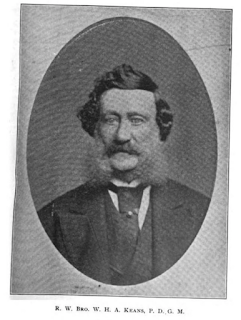
William Henry Alonzo Keans (1804 -1876): Revered Leader in the City of Saint John – and Child of a British Soldier


from History of Saint John's Lodge F.&A.M. New Brunswick
William Franklin Bunting 1895
I have been chasing down a bit of a mystery the past few weeks – one I thought I had solved, then not solved, then solved again, and now I am just not sure.  I sought the help of the Nova Scotia archives (they are amazing), who were able to answer some questions, but it left me again without answers.  I would like to tell you what I know about one of my ancestors, William Henry Alonzo Keans, and then tell you what I don’t know, and then ask for your help. 

The Keans link to my family tree is through the Haywards.  Harvey Parlee Hayward (1861-1949) married Annie Everitt Anderson (1861-1929), who was the daughter of John Michael Anderson (1832-1910) and Eliza Keans (1839-1916).  Eliza is W.H.A. Keans’s daughter. 

William Henry Alonzo Keans (let’s call him “WHA” for short), married Lucy Ann Robinson in October 1827 in Saint John, New Brunswick.  Back in the early 1860s, WHA was listed as a general agent.  He must have been a capable fellow, because by 1866 he was the superintendent of weighers of coal and measurers of salt.  He was building a reputation in the city of Saint John as reliable and astute.  He had three young children: Anne, Eliza and George Frederick.  WHA and Eliza’s first child, Amelia Augusta, died in infancy.

WHA worked hard to build his reputation as a community member and leader.  He was an elected representative of the city of Saint John, a school trustee, magistrate, prohibitionist, President of the Mechanic’s Institute, the 25th Worshipful Master of the Saint John Masonic Lodge, and so much more.  I managed to pull out a few highlights so you can get a sense of the man, but a complete accounting would be a difficult venture.

Prohibitionist

WHA was an outspoken advocate for prohibition, an issue which divided Saint John in the 1850s.  He ran for and won a seat on the 1852 Common Council based on the temperance slate and as a member of the Total Abstinence Society.  According to Thomas W. Acheson’s historical account, Saint John: The Making of a Colonial Urban Community, Saint John became a city divided over this issue.  The elections put the temperance advocates in positions of power, denying liquor licences and enforcing the law, and enraging leading merchants, lawyers and other leaders of the community.  By 1856 the New Brunswick legislature had repealed the prohibition statute and most prohibitionists realized that being tied to that slate was not to their advantage in the long run.

WHA, a man of high ideals and principles, in an 1857 address to the Sons of Temperance, described the remaining prohibitionists as:
…a band of sons… for the sole purpose of advancing the true and with real interest in the work of reform… to persevere to the end in the sacred cause of human progress… The good must eventually triumph.  The God, in whom we rely, will turn and overturn until this destructive foe of our race shall meet with a doom proportional to his deserts.
With their membership more than halved, and most now residing in Saint John, there is no doubt that they all, including their then scribe WHA, felt beset from all sides – the last defenders of a cause in which they all believed, and which had brought them recently to positions of power in the city.

WHA’s position on prohibition may have fallen out of favour, but his reputation as a man of courage and principles was strengthened.

Mason

WHA seems to have built a solid community reputation through the Masonic Lodge.  He was initiated there on January 7, 1840, and held a number of positions including Secretary and Treasurer.  Admittedly I have had a hard time figuring out the Masons – they follow a path from initiation, to apprenticeship, to mastery, and the position titles and investitures seem to follow that path. WHA rose to the highest ranks in the Saint John Masonic Temple: exalted to the R.A. degree in 1846 (sounds like a heady title) and a Knight Templar in 1856.

On the 27th of September, 1876, WHA was unanimously elected Deputy Grand Master, and installed into his position on the 28th.  He addressed the members on his installation, referring to his failing health, and promising that “during so long as it pleased the Great Architect of the universe to prolong his life, his best services would be as ever devoted to the fraternity.”

It was two days later that WHA died.  The Masons passed resolutions in his honour, including the following:

…resolved, That his brethren bear testimony to the fact that he was ever an ardent and enthusiastic worker in all stations occupied by him, as worshipful master, treasurer, private member or other capacity; and to his untiring efforts in years gone by may, in a great measure, be attributed to the present prosperous and satisfactory condition of the lodge.  Beloved, respected and venerated, he has gone to “the narrow house appointed for all living,” full of years and honours.

The lodge was draped in mourning for three months.  When they collected again in November 1876, they had the opportunity to speak to his character and history with the lodge.  A personal tribute was also paid which described how WHA was seen by his brother Masons:

In adding my testimony to the worth of Bro. Keans, I can truly say that he was eminent in all the relations of public and private life; active and influential in the community as in the masonic fraternity which he so greatly loved ; zealous, methodical and punctual in all his undertakings; a warm and generous friend and a wise and discreet counsellor; decided and firm in his opinions; opposed to humbugs and shams; the work which his hands and brains found to do was done readily and energetically. His long and active life was expressed in a wide sphere of public and private activities, and in all he was faithful to every trust committed to his keeping.

Childhood and Early Life

I can find no primary records that help me decipher the early life of WHA.  My best lead is a secondary source:  the biographical sketch of WHA Keans written for the Masons and by those who knew him.  It would likely have been developed based on what WHA Keans told his masonic brethren.  As we know from our genealogical research, family stories are often embellished or changed to hide what was possibly a shameful past, or to project a more appropriate public persona. 

If we go on what the Masonic biographical sketch tells us, the basics are that WHA Keans was born 11 March 1804 at Ryde on the Isle of Wight.  He was the child of John Keans, a Captain and Quartermaster of the 60th Regiment of Rifles, and he spent his childhood in the British army.  John Keans was stationed at several West India Islands and then to Halifax where his regiment was disbanded.  WHA Keans spent a short time in his youth as a midshipman on the frigate “Rifleman”.  He arrived in the parish of Portland, Saint John from Halifax in 1825.  The rest of his life is well-documented in primary sources.

Who is John Keans?

Prior to WHA’s move to Saint John, there is nothing I can find about him that is definitive in the primary sources available to me.  That isn’t to say that there aren’t more sources available, just none I can access.  So, I went to my next best available source, which is the Mason’s biographical sketch, for clues.  John Keans was a soldier in the 60th Regiment of Foot in British Army recruited from his home on the Isle of Wight.  His service included time in the West Indies.

The Regimental Chronicle has only one quartermaster whose name resembles John Keans:  a John Kiens, quartermaster in the 3rd Battalion.  The 3rd battalion chronology is very consistent with the Masonic biographical sketch.

Fortunately, a fair bit has been written about the 60th Regiment, known in the latter part of the 1700s as the 60th Royal American Regiment of Foot.  The 60th Regiment of Foot was a sort of French Foreign Legion fighting for the British.  They were made up of non-British infantrymen, but the officers were British.  Originally the Regiment was authorized to be raised in 1755 to fight in North America.  Recruiting for the Regiment took place in Germany and with German colonists in North America. 

In 1775, the 3rd Battalion was raised, on the Isle of Wight, and stayed there until 1776, at which point they sailed to St. Augustin and Jamaica.  Over the following years the 3rd Battalion would see action in the Caribbean and in America, landing for the first time in Halifax in 1783.  The 3rd Battalion was decommissioned for the first time in that year. 


The Regimental Chronicle tells us that on September 22, 1787, the 3rd Battalion was raised in Chatham, England and “composed of foreign recruits.”  The “depot” is listed as the Isle of Wight.  They were then moved to the West Indies.  They transferred between the West Indies and Channel Islands over the following years. 

The history of the 5th Battalion is important here as well, as some were merged with the 3rd in 1808.  The 500 men recruited for this battalion were mostly Hessians: a name given to German riflemen recruited by the British.  There were others in this battalion as well, foreigners that had been displaced as a result of battles throughout the Napoleonic period.

The 3rd Battalion did not return to British soil after 1787 and continued their battles around the West Indies until 1816 when they arrived on North American shores in Halifax.  There they stayed, first as light infantry, and then decommissioned by 1819.

The first time John Kiens shows up on the Regimental Chronicle as a Quartermaster is 1816, with his “rank in regiment” as 6 April 1815.  The Chronicle, unfortunately, had some unreadable pages, but the last time we see him with certainty, as Quartermaster, is 1818.  The next readable page is 1822 and he is no longer there. The timeline certainly works for John Kiens to then be decommissioned to Halifax as a former Quartermaster of the 60th Regiment.  The facts seem aligned, except for the spelling of the name.  However, Keans is an anglicized version of the German Kiens.  Could WHA be of German heritage?


Since the facts line up with regard to John Kiens’s rank in the British Army and eventual decommissioning to Halifax, what else did I learn about John Kiens?  According to his army records, he married an Elizabeth in 1799 in Barbados.  This definitely means he was a private in the army at that time, and likely recruited into the 3rd Battalion in 1787.  Was he then a German recruit who joined the 3rd in Chatham?

The Quartermaster position in the British Army is drawn from the soldiers themselves and given the title Captain.  This lines up with the Biographical Sketch.  John Kiens may have been one of the Hessian soldiers that made up 30,000 British troops during the American Revolutionary War.  This potential German heritage however does not line up with WHA’s biography, nor the story that WHA himself told about his heritage.  He was deeply committed to his claimed British roots – speaking of it often and joining societies (like the Masons and the Albion society) that continued to support that claim.  It is either true or a fiction he created to hide his heritage.  He would regardless have grown up in the British Army and most certainly would have adopted the British traditions – and likely would have felt more British than German in any case.  This is all assuming John Kiens, Quartermaster and Captain of the 3rd Battalion, 60th Regiment of Foot is the same John Keans that the Masons write about in their Biographical Sketch of their former Grand Master WHA Keans.

Some records of John Kiens align, and others confuse the history.  Sergeant John Kiens marries Elizabeth Ival June 14, 1799 while stationed in the Barbados.  Elizabeth is from the Island of Saint Christophus.  Certainly, a marriage in 1799 works out for a timeline that sees WHA born in 1807.  However, John Kiens and the 3rd Battalion never went back to the Isle of Wight, so WHA could not have been born there.

Further, these same records show John and Elizabeth with three children:  Elanora (1816, Halifax), Amelia Augusta (1812, Martinique), and Guillaume (1814, Martinique).  No WHA.  Further, Guillaume is the French equivalent of William, and surely they would not have named two of their children William.  The record for Guillaume is in French and the hand-writing significantly less tidy than other records.  To be honest, some of it I am not sure I understand.  It certainly says that Guillaume was baptized as the legitimate son of John and Elizabeth.  However there are other notes that are probably worth understanding (another odd note here: I did find a record of a William Keans, living in Halifax, of German heritage, born around 1815, whose child is named Alonzo!  It is a different William from WHA, but I find the coincidence almost too much).

The record for Guillaume does not make sense for our William, as it would mean WHA married Lucy Ann Robinson at the age of 13.  Perhaps this completely eliminates John Kiens as the parent of William.  Perhaps the other writing on the document holds the clue.  However, if the Biography is right, there were no other John Kiens, Quartermasters of the 60th that fit the bill (and I reviewed all of the names for the relevant period). 


John Kiens received a 500 acre grant in Sherbrooke as a Quartermaster of the 60th Regiment when the Battalion was decommissioned.  His grant was in 1822, and he is listed with other members of his regiment in a grant listed as Captain William Ross et al. (my thanks to the Nova Scotia archives for taking the time to look it up for me as it was not available virtually).

We learned from the Biography that WHA spent some time in the British navy on the ship Rifleman.  There are no available records for that ship, and likely there wouldn’t have been any that listed a teenager in their ranks, as that is likely what he would have been while serving on that ship.  The ship was a Cruizer class brig-sloop that served, among other places, in Halifax and Jamaica.  Not knowing the details of how youth, children of British army, are possibly brought on board ships to work, it’s hard to say how and when WHA ended up on the Rifleman.
The illustrated London News 14 Dec 1850 showing The Rifleman pursuing a Brazilian slaver


The ship was in Halifax in 1814, Jamaica in 1817, and it was under repairs from 1820 to 1823.  It went to the Mediterranean after that.  It is very hard to say during which period and in which theatre of war WHA would have served, and no records provide proof of this claim.  If poor WHA served on the vessel while it was in New England capturing privateers, it would have been under the command of Commander Henry Edward Napier, during which time “Rifleman had more punishments, with a higher number of lashes, than any other British ship in New England waters.”  If so, it’s no surprise that he opted for a career outside of British armed services.  He certainly did not serve long enough to be entitled to a land grant.

What happened to John Kiens?

If in fact John Kiens of the records I have found is WHA’s father, there are several reasons for WHA, a man who has fashioned himself a proper English gentleman, a stalwart of the community, a magistrate, leader and prohibitionist, to disengage from his past.

The first is that his father, according to the records, is likely of German heritage.  All of the logical reasons listed above would suggest this: his rank, the history of the 60th, the spelling of his name among them.  One other piece of evidence is that his military record shows that one of his baptisms was presided over by the “Missionary to the Germans at Halifax”.

The second is that John Kiens, Quartermaster and Captain of the British Forces, who fought in some ugly campaigns in the West Indies and elsewhere, died in 1828.  A coroner’s inquest was held and it was found that John Kiens “hanged himself in a fit of Temporary derangement” (Halifax Acadian Reporter, 13 September 1828).  Given how recent his decommissioning and the fact that he was essentially fighting in wars most of his life, I think we can guess that his trauma made the stresses of colonial living difficult to bear, not to mention the likely PTSD he was suffering.

Here’s something else that’s weird.  We have been referring the subject of our research as WHA Keans – his full name being William Henry Alonzo Keans.  Alonzo is a strikingly odd name for an Englishman – and perhaps why he went with WHA for his public persona.  It is, however, a German name (it’s also Italian). 

This is a mystery that I have not been able to solve.  Almost everything points to John Kiens as WHA’s father but one fact:  there is no record of his birth in the John Kiens’s military file.  It is possible it fell out – as other pages were included with paper clips.  The files are, after all, more than 200 years old.  But it begs the question as to why they would name another of their children Guillaume.

If WHA is not the child of John Kiens, then the Masonic Biographical Sketch is full of odd inaccuracies that make no sense to randomly put into someone’s biography.  Why would you make up the father being the Quartermaster of the 60th, spending time in Martinique, and so on.

I am hoping that posting this blog will discover others looking into this mystery who have information that could help.  For now, I surrender to my limitations and hope that new clues will emerge over time.

Postscript:  Literally the next day I am looking at notes and realize that WHA's first daughter, Amelia Augusta Keans, who died in infancy, has exactly the same name as John Kiens first daughter as noted in the military records.  Too many coincidences.