Showing posts with label Davies. Show all posts

Sunday, 21 February 2016

Breaking the Cycle of Poverty: A Story of Unwed Mothers in the 18th and 19th Centuries

Shoreditch in the 17th century with the walled city
of London in the background
James Philpot was born in 1767 to Philip and Arabella.  He was baptized in Shoreditch, which was also at the time a place for crafthouses and small agricultural production.   James met Maria Boydell around 1780, and they decided to marry and move to Bethnal Green to make a new life there.  James seems to have been successful, whether at farming or some craft.  He leased land and managed to pay taxes owed to the British landowner in the Tower Hamlets of Bethnal Green. Bethnal Green at the end of the 18th century was its own parish whose purpose seemed mainly to provide for the residents of the ever-growing City of London.

Tower Hamlets in the 18th century was a diverse community of Irish weavers, Ashkenazi Jews and folks from the country. It was still a collection of small settlements surrounded by farms, but this changed dramatically as the years progressed.  It transformed through that century from mainly agricultural interests to cottage industries, including weaving.  James, though, with his wife Maria, made a life for themselves and welcomed to the family at least two children, a son John and a daughter Charlotte.  Both born in the latter part of the 18th century, they would have watched as their sleepy hamlet of industrious weavers and farmers became ever more crowded. 

Charlotte grew up in this increasingly chaotic life, as the boroughs started to be swallowed by the busy city next door.  The population density increased dangerously.  Poverty and cramped quarters took over from sleepy hamlets and agricultural pursuits.  Beside and around Charlotte was a growing refugee and immigrant population.  Ashkenazi Jews were escaping pogroms and persecution from other parts of Europe and settling here.  The Irish brought their weaving skills.  More and more, Charlotte’s surroundings became like a city. 

Charlotte’s father James, and later his son John, continued to work the land, and rent from the local landowner.  Bethnal Green, once the centre for agricultural industry to feed the London populace, would become one of the poorest slums in London.  It became infamous as the stomping grounds of the notorious Jack the Ripper, who found the most vulnerable women as prey.  Tower Hamlets, a sleepy borough of Bethnal Green would be known as the East End of London.  While the East End is now renowned for trendy restaurants and musical productions, in the 18th century it attracted the poor and immigrants who were trying to make a go of it in the big city, likely leaving the agrarian life of the countryside behind.

Charlotte’s life as an adult was troubled.  Who knows whether she fell for a man, or somehow ended up on the streets of London alone and vulnerable.  Regardless, she didn’t leave the Tower Hamlets, and it was there, at the age of 20, and without a husband, that she gave birth to a daughter: Sarah Davies.  There is a family storyabout some Jewish parentage.  Given the neighbourhood was a refuge for fleeing Ashkenazi Jews, and the possible Jewish roots of the name Davies, it is possible that Sarah’s father was Jewish.  However recent DNA testing seems to refute that theory. 

Sarah would never know her father, and her mother Charlotte had a difficult time making ends meet.  Born into poverty, Sarah herself lived in and out of workhouses.  Giving birth to a child without a father would have made it difficult for Charlotte to get work and care for Sarah.  There is no doubt that they struggled to make ends meet.

If you gave birth to an illegitimate child, there was an expectation that you would make best efforts to find the father to manage the care.  Relief for the poor was managed by parishes, and individual donations were what supported poverty relief.  There was very little government care, so the poor were guaranteed a difficult burden, and poor unwed mothers doubly so. 

Workhouses were developed in the early 1700s as a way to shelter and feed the poor, and train the children of the poor as labourers and servants.    Some workhouses were very large and accommodated hundreds of paupers. One such place was St George in the East workhouse, which is where Charlotte Philpot found herself as she neared her 50th year, having lived a life of poverty in Tower Hamlets.  It seems she never married.  She was ailing and unable to care for herself.  You don’t need to read Dickens to imagine the life she led.  She would have been tired, nearing another cold winter likely without work or proper shelter. She was admitted on her own, and died there on September 2, 1834.

Notation beside Charlotte's name
in this discharge record says "died".
Charlotte left behind a daughter Sarah.  Just like her mother, Sarah gave birth to a child at the age of 20.  She was not married, and this time her child took his mother’s surname: Davies.  Having eked out a living to that point, Sarah’s only option to give birth was in the workhouse.  On June 28, 1825, Sarah, likely scared and alone, checked herself into the workhouse.  Her child’s first admission to a workhouse was the day of his birth, July 3, six days later.  Both were released August 15 with an allowance of 1 shilling 6 pence per week.  Sarah understood the system, and she is what was known as an “in and out”: someone who frequented the workhouse to get a dry bed, a meal and a break from the depressive poverty of London.

Edward's first admission to a workhouse was on the day of his birth.
In the 1830s, when Edward was still a youngster, England was suffering an economic downturn.  The numbers of poor flocking to London was staggering, pushing expenditures on poor relief to 7 million pounds per year (more than a three-fold increase from the end of the 18th century).  After a Royal Commission studied poor relief in 1832, government moved to the creation of Poor Law Unions which each had a workhouse.  The poor were to be housed, and not given any other type of relief.  The only respite became admission to the workhouse.  It was in these institutions that up to 6.5 per cent of the British population was housed at any given time.  

Workhouses were walled-in institutions.  Inmates were classified as infirm, poor, or mentally ill.  There was one entrance, and a bureaucracy to manage admissions and discharges.  Workhouses became a bit of a business, requiring bureaucratic oversight, and in some areas workhouses were a private enterprise.  Inmates, including children, were set to work to offset the costs of running the institution and perhaps even make a profit.  Some workhouses offered their inmates as apprentices and would even pay an employer to take on an apprentice, ridding themselves of the burden.

 
Genders were separated, regardless of family relationship (infants under 2 years of age could stay with their mothers).  Boys (under 14) were separated from men and girls from women.  Everything was taken from you as you entered, to be returned from storage after discharge.  There was a uniform of sorts.  Everything about the workhouse resembled jail.  Conditions were kept in a poor state in order to discourage poverty.  The food was decent, though, and you can imagine that the thought of a good meal and a bed, in whatever conditions, was enough to ensure that Edward and Sarah would return frequently.

In 1841, Edward was considered a prisoner of St Margaret’s workhouse and worked as a labourer.  Imagine that the workhouse could house 420 inmates and had been operating for 100 years by the time Edward was a resident/prisoner.  Growing up in a workhouse, which seems to have been Edward’s lot, meant learning to read and working at general labour, such as spinning wool.  This was not a happy place for a youngster, but it seems that well over half of the inmates in this workhouse were children. For a poor illegitimate child, it's possible the workhouse offered the most comfortable housing with the only possibility of learning a trade.

Boys at a workhouse around the time Edward would have been an inmate
Sarah meanwhile was trying to make a life for herself as a hawker.  In 1852, Sarah and Edward’s circumstances seemed to have changed for the better.  They were living with a roommate.  Edward was learning his trade as a French polisher, while Sarah appears to have picked up a job as a servant, like their roommate.  Things were looking up for the Davies family.  This was the last time, though that we can find a happy circumstance for Sarah.

Census record showing Sarah and Edward living together
It is hard to know precisely what happened to Sarah, but it appears as though her life in the workhouses wasn’t quite over.  After 1853, when Edward marries Susannah Futcher, Sarah seems to disappear from his life.  She continues her life as an “in and out”, and, like a mirror of her mother, finds herself alone and ill at the age of 50 or so.  Her reasons for discharge from the workhouse read: “dead”.  It is possible this is not our Sarah, but what we know for certain is that she never lived with Edward after he married and began to have children.  The last time Sarah and Edward lived together was 1851.  From that point, Sarah seems to have been unable to break free from the life of poverty. 

It’s hard to say why Edward seems to have left his mother alone.  We can only imagine that he was tired of the life he was leading.  He had an opportunity, with a wife and a trade, to break free, and perhaps to him that meant leaving everything behind, including his mother.  We can only imagine the trauma of working in a workhouse crammed with children and perhaps not being able to see a chance of escape.  He would  not have had a strong bond with Sarah, because they would have only been together in the periods they were not in the workhouse.

Sarah and Charlotte lived parallel lives: both giving birth to illegitimate children when they were 20, living in and out of workhouses, and then sadly dying alone in one.  It was Charlotte’s grand-son, and Sarah’s son, though, who managed, by getting a trade, to break free of poverty.  It is interesting that even today, breaking free from poverty often means generations of struggle and the right combination of education, circumstance and perseverance to make it happen.  For Edward, the workhouse is ironically where he would have found his means of survival and ultimately spell the end of the cycle for the Davies family, and consequently also the Bonds.


Sources:
Various Census, workhouse, tax and other primary documents
http://www.british-history.ac.uk/survey-london/vol8/pp40-47   

Monday, 5 October 2015

Shoreditch: Crafts to Cafés

Pedigree chart for the Davies,
showing my paternal great-
grandmother
In the news this week was the protest by anarchists against a recently opened Cereal Killer Café.  The Café was, according to the protesters, a sign of the ongoing gentrification of Shoreditch, a part of London long the home for the less well-to-do.  The concern, as is always the case with gentrification, is that the residents would no longer be able to afford to live there, and as one of the only remaining less expensive parts of London, they would be forced further out of town. 

When I heard the report on CBC radio, I remembered Shoreditch from the family records.  It took me a bit, but I located Shoreditch as the home of the Davies family.  The Davies are related to me through my paternal grandfather.  You might recall Sarah Davies and her son Edward from an earlier blog where I tried to uncover the truth behind a family legend, which I now suspect is one of a Victorian-era bastard. 

Davies family census 1861
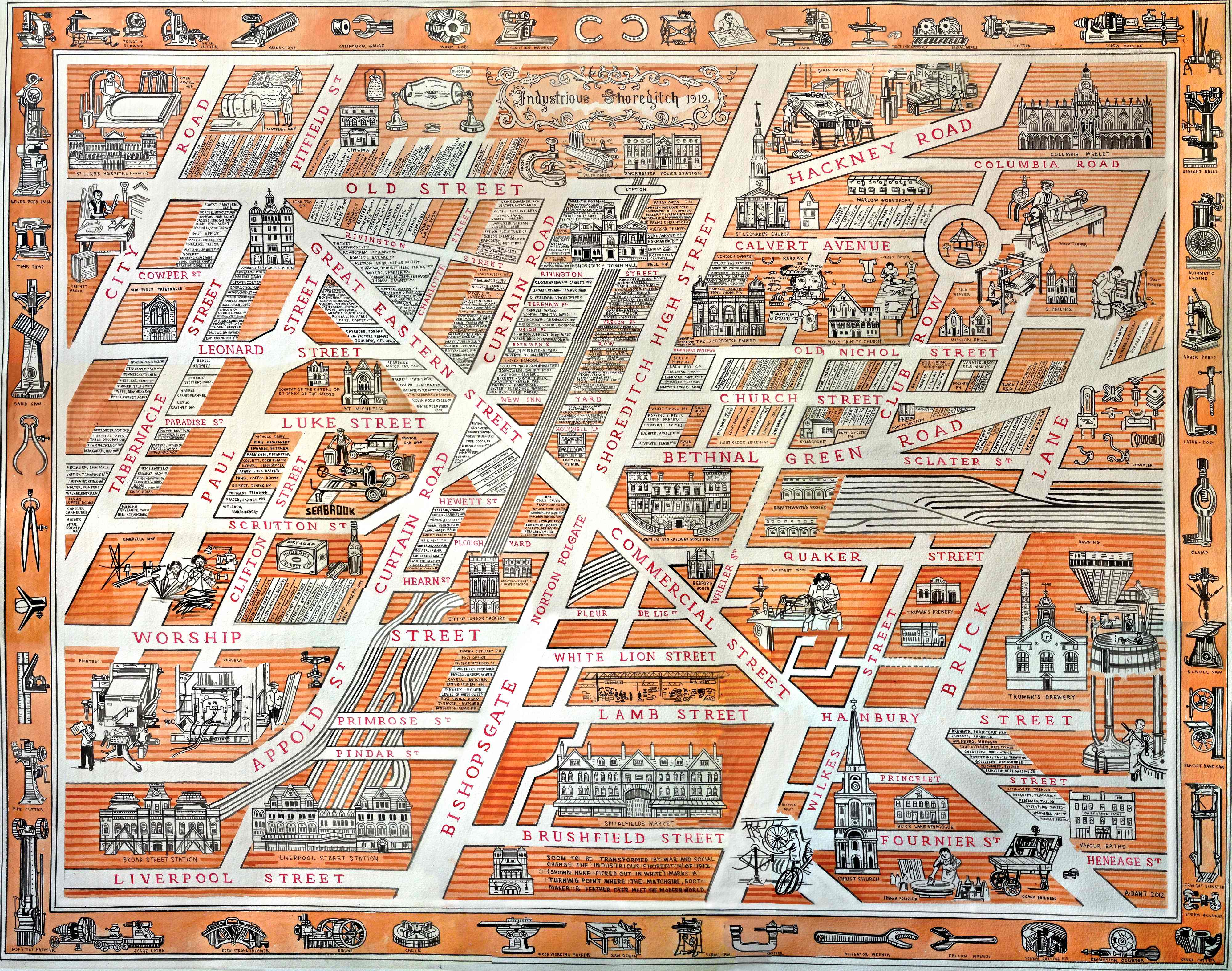
Almost a century ago, Shoreditch was known for its crafts industry, industrial workers and skilled trades.  Our ancestors were French polishers and hatters.  I stumbled across a map of old Shoreditch (circa 1912) actually created in stunning detail by current artist Adam Dant (featured on a blog about the area called Spitalfields Life).  It’s worth checking out the link because you can see where the different trades and crafts did their work.  There are plenty of places manufacturing varnish (useful for our French polisher Edward Lane Davies), along with furniture makers.    Interestingly, there is also a small synagogue?  Perhaps Sarah met a “foreigner of Jewish origins” after all?

Adam Dant's map of Shoreditch
Shoreditch continued its evolution as London moved on in its industrial growth and its gentrification took off in the last couple of decades as the dot.com industry started moving in.  Commercial endeavours sprang up to support those working in the industry, then hipsters, and now cafés which cater to them… including ones specializing in cereals that your mother would never dare feed you…  Count Chocula anyone?

Sources:
Birth record for Edward Davies 1825
Census record for 1841, 1861
http://cerealkillercafe.co.uk/

Sunday, 16 November 2014

Unraveling the Mystery of the Young Girl from Hereford and the Foreigner of Jewish Origins

Many years ago, my father intrigued me with a story of our family secrets – tracing back to a young girl from Hereford and a “foreigner of Jewish origins.”  Needless to say, when I started to undertake a study of our family stories, this one I had to figure out!  The genesis of the legend can be found in a memoire recounted by Beresford Day Davies (dated October 6, 1985).  Beresford’s story is also interesting and shrouded in even more family shame and secrecy, but that is a story for another time. Beresford talks of how his father, Edward Futcher Davies (1881-1936) was the son of a hatter, who was himself the “illegitimate son of a young girl who came to London from Hereford and had a liaison with a well-to-do foreigner of Jewish origins.”
We are not amused by bastards!

It’s probably worthwhile to describe what England would have been like for the bastard son of a Jew in the early- to mid-1800s.

Queen Victoria took the throne of England in 1837 to 1901. The United Kingdom was a well-entrenched constitutional monarchy, which became more so as Queen Victoria’s reign continued.  As a result, Queen Victoria’s power came from the moral influence she could exert on the population, and she focused on “family values”.  Victorian England is therefore known for its strict moral standards.  Being a bastard in this era was, needless to say, less than acceptable, and the law didn’t help.

Victorian England’s Bastardy Clause focused on punishing the mother and absolving the father of any responsibility.  The intent was to dissuade loose women from sexual liaisons out of wedlock.  This had the predictable effect of sending unwed mothers into lives of poverty at workhouses, and their children to suffer along with them.  Unwed mothers were scorned by Victorian society, and their illegitimate offspring ostracized.

I found it interesting that the father in our story was described as of “Jewish origins.” Jews had been in England since the Norman Conquest of 1066, and tolerance and discrimination had waxed and waned in the centuries since.  By the mid-19th century, while still relatively unknown to most British citizens because of their small population, Jews found themselves emancipated and were allowed to sit in Parliament.  In fact, it seems that being an unwed mother or a bastard was considered far more offensive in this relatively religiously tolerant society than being a Jew was in most of the rest of Europe.

To find who the young girl from Hereford was, and perhaps even to find the foreigner of Jewish origins, first I had to find the hatter that was their son.  To do that, I had to find Edward Futcher Davies.  I soon discovered two men by the name Edward Futcher Davies: Junior and Senior.  EFD Jr. (1881-1936) was the father of Beresford Day Davies (to whom the memoire is attributed).  EFD Jr. lived his whole life in London, and was a bank clerk, beginning his occupation sometime before his 20th year. 

In 1901, EFD Jr. was living with his father and mother.  EFD Sr. (1848-1926) was working as a silk hatter. EFD Sr., according to Beresford’s memoire, was “rather withdrawn in family circles.”  This was attributed to the fact that he was the “illegitimate son of a young girl who came to London from Hereford and had a liaison with a well-to-do foreigner of Jewish origins.”

Interestingly, I have been able to trace EFD Sr.’s father, who was a French polisher named Edward Lane Davies (1825–1902).  He was married to Susannah Futcher, EFD Sr.’s mother.  So the father here is not unknown, and Susannah is from Shoreditch in London (not Hereford).  Maybe it was Edward Lane Davies’s father and mother that were the cause of the family secrecy?  This is where my trail gets murkier, but I can certainly, based on evidence, construct the following story that makes some sense from the facts that I have discovered.

The Story of Edward Lane Davies

Sarah Davies found herself quite alone when she gave birth to her son Edward in 1825 in Shoreditch, London, England. No father was listed on the birth or baptism records, so baby Edward started his life as a bastard.  Victorian values were strong, and an illegitimate child to a young mother would have been nothing more than a burden.  While Sarah may have tried to make a life for herself and her son, she had no chance of seeking any help from the father.  The poor laws were against her.
St.Luke's workhouse circa 1830

Eventually, her son, and perhaps even Sarah herself, needed relief from the poverty in which they found themselves.  The nearby St.Luke’s workhouse offered shelter, but this was coupled with demanding conditions.  For a poor family, though, the workhouse was the only way that Sarah could guarantee that her only son Edward received the necessities of life, and some semblance of an education. 

Living in the workhouse meant that Sarah saw her son very little, and contributed even less to his upbringing.  She knew that her choices were limited, and her son’s even less so.  The workhouse at St.Luke’s became their home, though they were mostly separated from one another.

When he was a teenager, Edward left the workhouse to fend for himself.  His life in St.Luke’s had been regimented, and life outside the institution offered a freedom he didn’t know he could have.

Ironmonger's Row is just around the corner
In 1841, Edward, as a fifteen-year-old, was living with a number of others, mostly men, on Ironmongers Row in London, quite near St.Luke’s.  There, even without a trade, he could get by on his own.  His mother Sarah, to whom he had never been close as a result of their separation in the workhouse, was no longer a part of his life, and she never would be again.

In his 20s, Edward renamed himself Edward Lane Davies, to create a new persona perhaps, one that captured his birth mother, but also represented his desire to be something more than his accidental birth.  He was, perhaps, imagining his birth as one that did not come with the title “bastard”.

In the late 1840s, Edward Lane fell for Susannah Futcher, from Andover in Hampshire.   As one of 11 children, and the oldest girl, Susannah was sent to London to find work to help support her father, William Futcher, a sawyer.  Like Edward Lane, she was seeking escape.  Edward and Susannah soon found each other while living in the poorer parts of London, and shortly after had a son, whom they named Edward Futcher Davies.  They moved in together, unmarried, to an apartment at 11 Charles Place in Shoreditch, London. 

Watching his grand-child being raised outside of a Victorian family unit didn’t sit well with William Futcher.  He travelled from Andover to insist that Susannah and Edward marry and raise their family properly.  They did, at the parish church at St. Leonard’s in Shoreditch on January 30, 1853.  The curator, Mr. Attwood, recorded the marriage.  He turned to Edward to find out the name of Edward’s absent father, and Edward, facetiously, replied “Adam”.  Mr. Attwood dutifully recorded the name until he realized that Edward was referring to the human male of biblical origins, and crossed the name off in exasperation.

With that, Edward and Susannah began their legal union.  William Futcher, in an effort to ensure that his daughter and grand-child had as comfortable a life as possible, set Edward up with some of the craftsmen who received the planks that William prepared as a sawyer.  They trained Edward as a French polisher, and he would bring their custom cabinetry to a fine finish suitable for the homes of the upper classes. 

By 1861, Edward and Susannah had two sons.  Edward Futcher (Sr.), at age 13 had already left school and was an errand boy, helping to support his family.  Thomas Lane was just two years old.  Edward Lane never talked to his children about his up-bringing in the workhouse.  His life with Susannah and his work in a trade was what his children needed to know and what would keep the dark stain of bastardy away from his progeny.

Edward Futcher Davies Jr. left home before the end of the next decade, marrying Annie Cole in 1871 and working as a silk hatter.

By 1891, Edward Lane Davies had lost his wife Susannah and moved in with his second son Thomas, now working as a sanitary inspector and himself married with a four-year-old son.

Edward Lane Davies, born a bastard in Victorian England, living independently, finding love on Ironmongers Row, and a trade as a French polisher, died on August 16, 1902, aged 77 years.  In his later years, he would tell his son Thomas hints about the story of his humble roots.  This story has changed over the generations.  Perhaps Edward Lane imagined that his father was "well-to-do", and the hint of mystery that came with "foreigner of Jewish origins" made the whole story less unseemly.  So, while we don’t know the foreigner of Jewish origins, we do know that our ancestors were scrappy, and sought to make something of a life that would have doomed many to failure.  I like to think that tenacity is the legacy of Edward Futcher Sr., the hatter, Edward Lane Davies, the French Polisher, and Sarah, the girl who fell for a man who left her and her infant son to fend for themselves in the workhouses of London.  


Sources:
I am absolutely certain about the facts up to and including the year and location of Edward Lane Davies’s birth.  I found a birth record for an Edward with only a mother (Sarah Davies) listed.  The name, date and location are all consistent with ELD, and the fact that there is no father listed is consistent with the family story.  There are no other records that I can access until Edward Lane is 15. An Edward Davies shows up on the census of 1841 living on his own in Saint Luke’s Parish at Ironmonger Row, right beside Saint Luke’s, which was a workhouse.  It is not too much of a stretch to consider that the workhouse guardians would send their wards out close by once they became teenagers.  The records for Saint Luke’s residents for the time period Edward would have been there are not accessible to me from my armchair.  I am absolutely certain of the marriage to Susannah Futcher, and the marriage record does show Edward Lane Davies’s father as Adam, with the name scratched out.

Updated October 5, 2015:
I have found a Shoreditch workhouse record with our Sarah and Edward listed.  It seems certain now Sarah started out her new family's life in the workhouse.  This is a workhouse record.  The columns are: name_age_ward_date admitted (year is 1825)_date discharged_remarks.  There is Sarah with her newborn admitted in June, baby born July, discharged the same year in August.  I am not entirely certain what the remarks say.


Primary Sources:
Census (various)
Marriage (various)
Birth and Baptism records (various)
Death and Probate records (various)

Secondary Sources:
Bastardy and Baby Farming in Victorian England by Dorothy L. Haller
http://en.wikipedia.org/wiki/History_of_the_Jews_in_England